Category: country

Douse Croft Lane to the valley top

  • Douse Croft Lane to the valley top
  • Length: 1.12 miles
  • Avg gradient: 6%   Peak gradient: 14%
  • Difficulty: 3/5
  • Likelihood of encountering unpleasant motor-vehicles: 1/5
  • Elevation gain: 377 ft 
  • Strava

Situated out in the lovely Mayfield Valley, this hill is snuggled out amongst a wealth of winding country hills. It’s an area well worth exploring and never too far from civilisation.

You’ll approach this climb from either Brown Hills Lane or Harrison Lane, both of which send you down Gorse Lane. It’s quite a speedy drop with a sharp, blind bend just before you hit the climb. For safety’s sake you’ll need to pull on the brakes which unfortunately will cost you some momentum for the start of the climb.
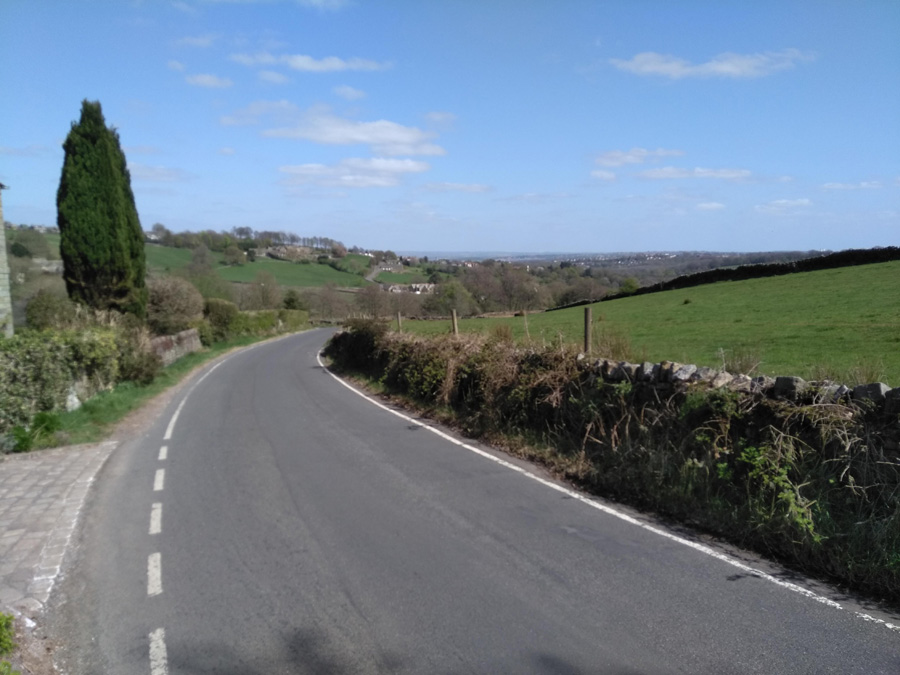
One of the consolations of this hill is that the toughest parts are out of the way first, including the immediate sharp bend to the right at 14%. Once you’re around that, you can see the next bend approaching but the gradient only drops a few points here, and surprisingly, shows up as less steep around the switchback. It certainly doesn’t feel easier.

Wiggle your way up, as the Mayfield Valley opens up on your left, and around the next right hand bend, with the gradient remaining in the low double figures as you pass Harrop Lane on the left. You’ve now got a steady 6-7% climb for about 0.3 miles, returning to double figures as you approach the cottage and the junction to Fulwood Lane, where you turn right.

The hard bit is done now but it’s worth carrying on. The road floats around the low single figures and only once briefly touches 6% (it’s this section that has reduced the average gradient of the segment) but the views over the valley towards Sheffield are lovely. Once you’re reached the top you’ll be greeted with one of my favourite vistas of Sheffield.

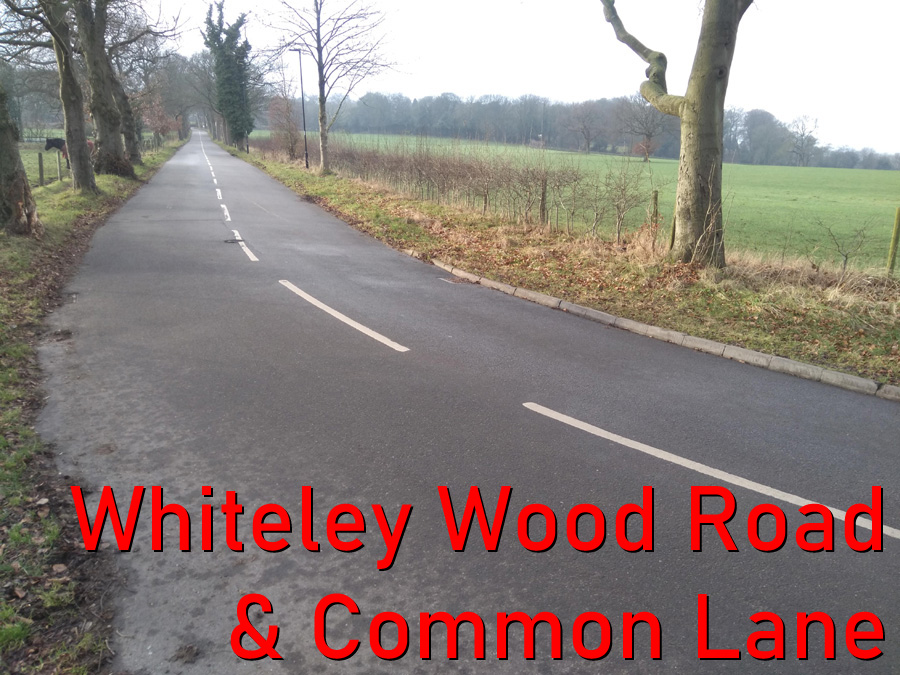
Whiteley Wood Road and Common Lane

  • Whiteley Woods Road and Common Lane
  • Length: 0.88 miles
  • Avg gradient: 6.6%   Peak gradient: 12%
  • Difficulty: 3/5
  • Likelihood of encountering unpleasant motor-vehicles: 3/5
  • Elevation gain: 308 ft
  • Strava

This is a utilitarian climb, in that it sole function is pretty much to get you out of suburbia, towards the Peak District. At the top, you’re on the edge of the countryside, ready to discover some absolutely lovely views.

The climb begins after a quick descent on Whitely Woods Road as it cuts through the woods themselves. The climb begins as you cross over the Porter Brook but it’s nothing serious here, as the gradient remains in the low single figures until you reach Wire Mill Dam. As the road curves left, the gradient creeps up but it still remains in single figures, where it stays for the short, straight section to the next bend.
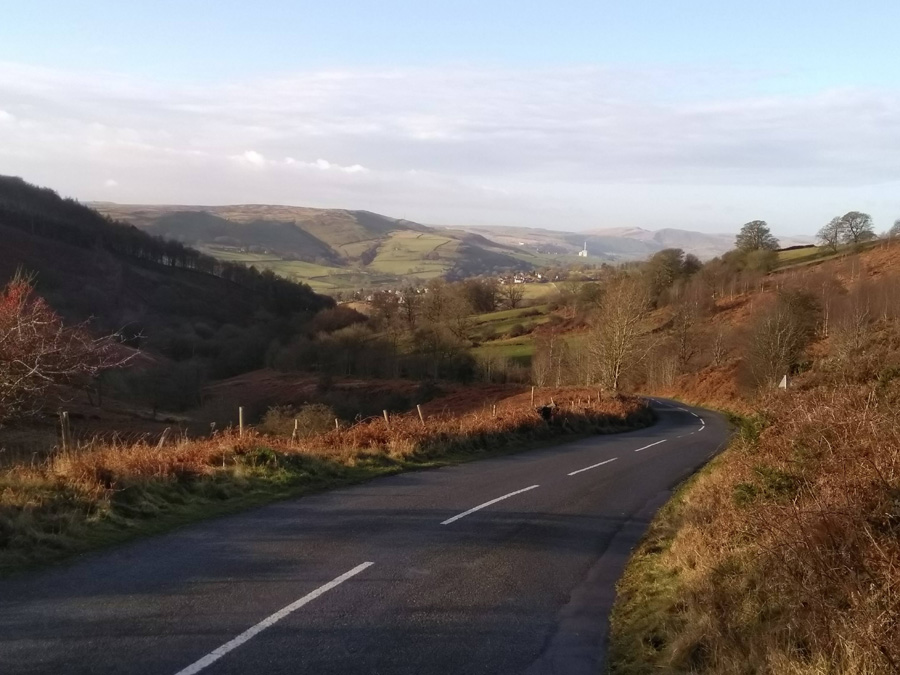
The battle begins after you follow the road round the bend. It’s only 0.2 miles but it’s a slog. It gets slowly steeper as you grind up, hitting a peak of a 10.5% just before the cattery. However, the challenge here is more psychological than physical because the hill is so straight and with slightly boring fields either side there’s not much to look at on your way.

When you’re past the cattery, the road bends left once more and you’re well on your way to the apex as, shortly after, you turn onto Common Lane. From here, with every pedal, the gradient drops away and you find yourself at the start of Ringinglow Road, ready to get out to the Peaks.

Curbar Edge

  • Length: 1.1 miles
  • Avg gradient: 10%   Peak gradient: 15.2%
  • Difficulty: 4/5
  • Likelihood of encountering unpleasant motor-vehicles: 1/5
  • Elevation gain: 598 ft
  • Strava

There is pretty much nothing that I can say about Curbar Edge that hasn’t already been said in greater detail and with more authority elsewhere, not least Simon Warren’s 100 Greatest Cycling Climbs and James Allen’s 50 Classic Cycle Climbs but as it is what I’d consider a headline hill, it would be remiss of me to not include it here.

I’d driven up to Curbar Gap many times before, heading for family walks along the edge, so I was familiar with the hill, its two sweeping bends and the towering gritstone rocks that give the hill its character. It’s an even more impressive climb when you’re on a bike.

You start in the village of Curbar itself, next to All Saint’s Church, and it’s from here that you head up the innocuous looking Curbar Lane. As you pass The Old Vicarage on your right, the gradient is immediately into double figures, reaching 14.5% as the road bends to the right. This is the steepest section of the whole climb, which is a good thought to keep in mind as you progress up the hill, eventually passing a red telephone box at a crossroads.

The climb now drops to a more pleasant 6-7% for a straight section, lined with rather nice looking houses with big gardens. You’ve pretty much reached the halfway mark when you pass the national speed limit sign, which sees the gradient return to around 10-11% and, more impressively, the countryside open up and the appearance of Curbar Edge, loom ominously above you.

The steepness remains fairly consistent around the first sweeping bend and then reaches 11.5% as you head towards the second, sharper corner. The views from here more than make up for the additional challenge though. Just try not to focus on the ridge of Curbar Gap which, at this point, still seems very high up and very far away.

Grind on around the next bend and, once you’ve passed a gate into a field on your right, I always feel like you’re pretty much there. You still have to cycle 0.3 miles and climb 130 ft but it’s broadly straight with a gradient of less than 10% and the views alone will keep your legs powered until you reach the car park at the peak.

Curbar Edge is a beautiful climb worth travelling for.

Wheel Lane & Coldwell Hill

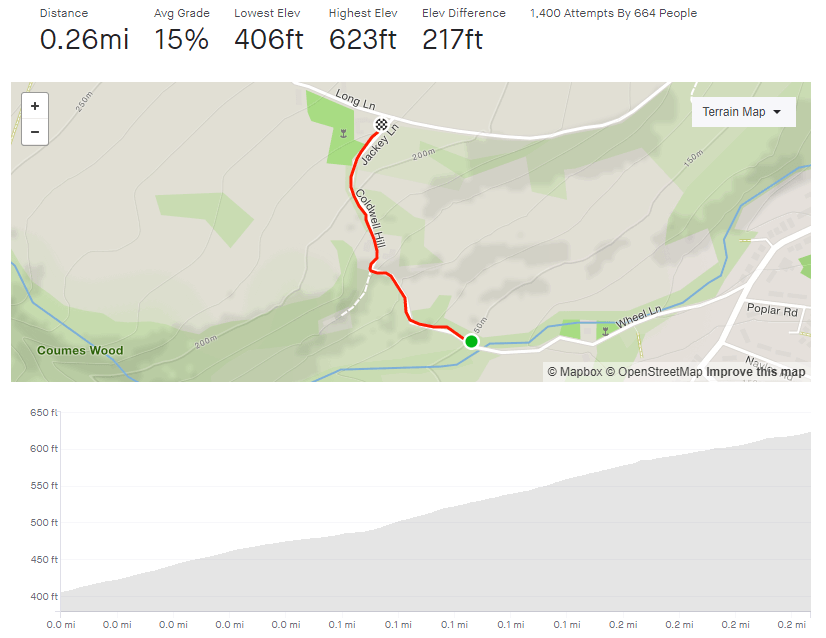
  • Wheel Lane & Coldwell Hill
  • Length: 0.26 miles
  • Avg gradient: 15.4%   Peak gradient: 17.7%
  • Difficulty: 4/5
  • Likelihood of encountering unpleasant motor-vehicles: 1/5
  • Elevation gain: 217 ft 
  • Strava

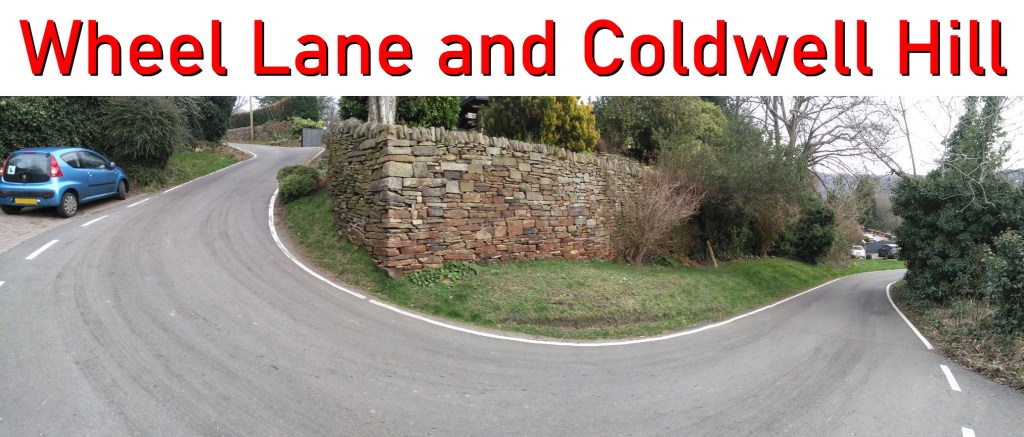
A hidden gem of a hill climb, tucked away in the hills outside Oughtibridge. It’s just over a quarter of a mile long but look how close the average and peak gradients are.  That tells you that it’s a very unwavering climb all the way to the top.  And your reward for getting there?  Another hill.

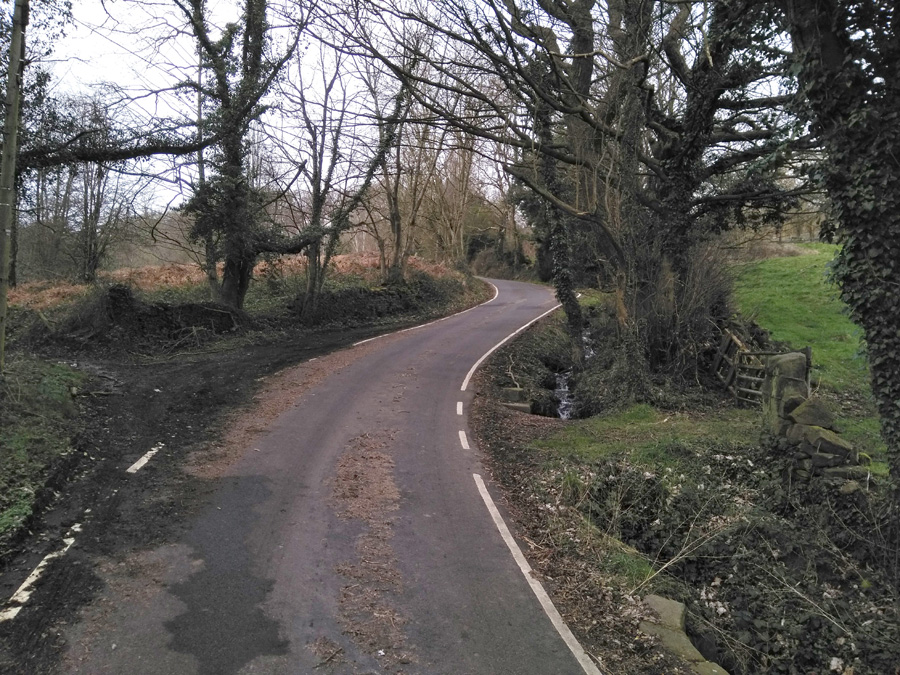
As soon as you pass over the brook (which is liable to flooding in rainy periods) the hill begins with a little weave and a gradient of around 17%. Climb up this until the road makes a sharp right turn and a sign tells you that you’re now on Coldwell Hill. You’ll pass the first of the houses and a grit bin on your right, which makes you wonder how brave you’d have to be to drive up here in icy conditions.  It’s hard to believe but, at about 9%, this is the flattest section of the climb.

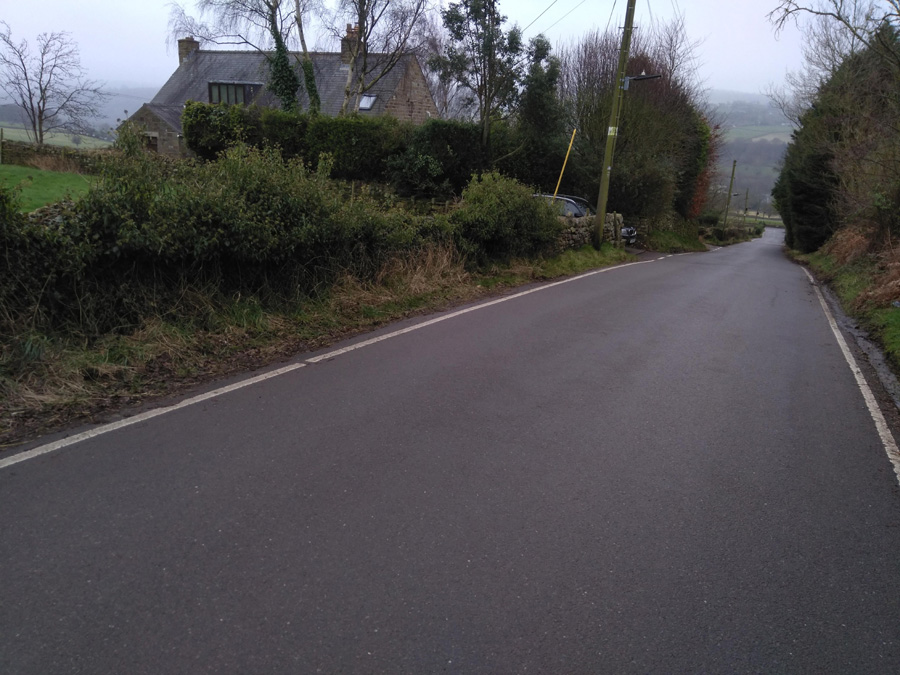
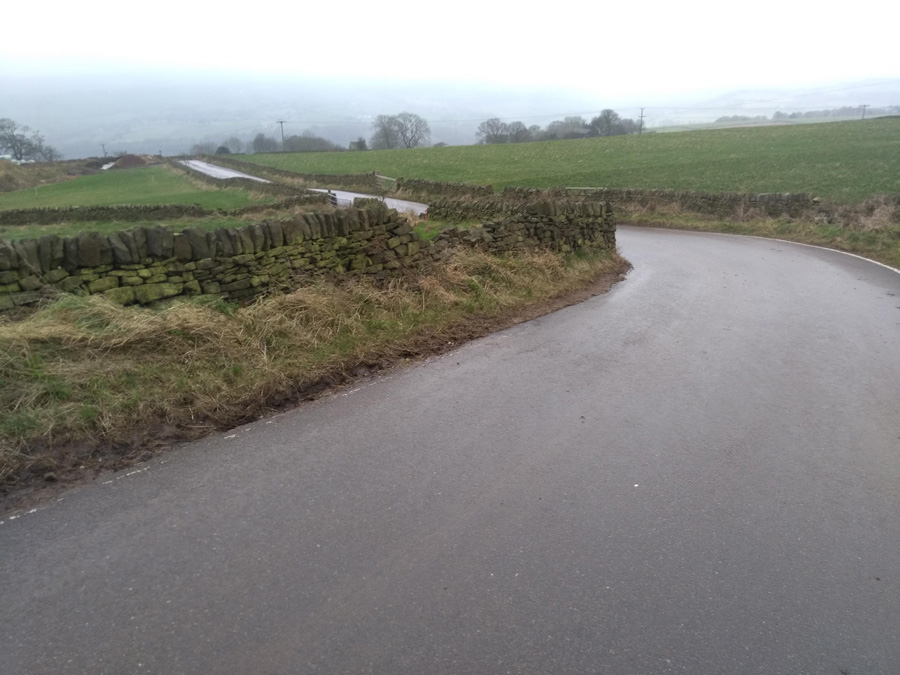
That’s soon forgotten however, as you wind round a dogleg bend with the steepest incline of the hill. As you curve past the row of quaint cottages you’ll be thinking that this must be it but you’re only about half way up. You’ve got a slightly straighter climb now but still averaging 15%. Shortly, the climb takes another sweep right and after a brief section of tree-lined road, another sign tells you that you’ve joined Jackey Lane for the final 600 ft.

Well done, you’ve just made it up one of my favourite Sheffield cycling climbs. From here, turn right and drop back into Oughtibridge or, if you fancy continuing the challenge, turn left onto Green Lane and tackle another mile or so of 8% out into the countryside.

Loxley to Kirk Edge

  • Loxley to Kirk Edge
  • Length: 1 mile
  • Avg gradient: 10.4%   Peak gradient: 15.9%
  • Difficulty: 3/5
  • Likelihood of encountering unpleasant motor-vehicles: 1/5
  • Strava

I was introduced to this road, which featured in the 2017 Magnificent 7, when out with my pizza-and-beer cycling club. The usual ride leader wasn’t able to come so the ride was led by one of the riders who likes to do hill reps. He zoomed up here, the rest of us puffed and panted after him.

If you’re heading from the city, you’ll have probably already climbed almost 250ft up Loxley Road before you reach West Lane and the start of this hill. That’s not too much of challenge but it is a bit of a slog, so make sure you’re not blitzing it up there and not leaving enough in the tank for this climb.

Turning right, on to West Lane, you’re immediately on a 10-11% gradient for the first, dead-straight, 0.3 miles. Just dig in here as the road will eventually get a bit more interesting. Soon enough, you’ll reach the first bend, with a farmhouse on the left, and the one of the the climb’s steepest sections, at 15.9%, shortly after. At the halfway mark, as Meyers Lane joins from the right, the gradient reduces for a short distance before ramping right up again as you pass Green End Farm, and on into the hamlet of Holdsworth.

The road wiggles through farmhouses, barns, and the sounds and smells of the countryside and you’ll soon have fields on either side.  With 0.2 miles to go, the road has a bend to the right, then a straight section with an incline of around 7% (my three sources all disagree about the exact figure), followed by this climb’s sting-in-the-tail: a little dog-leg of about 15.9%, the end of which is marked by a telegraph pole.

Once you reach the pole, pootle to the end of the road and turn left towards Bradfield or right for an extremely enjoyable descent into Worrall and Wadsley.

Rails Road

  • Rails Road
  • Length: 0.42 miles 
  • Avg gradient: 8.5%   Peak gradient: 14.7%
  • Difficulty: 3/5
  • Likelihood of encountering unpleasant motor-vehicles: 2/5
  • Strava

If Lodge Lane is the bad cop, the Rails Road is the good cop. It might be slightly easier on you but you’re still in trouble.

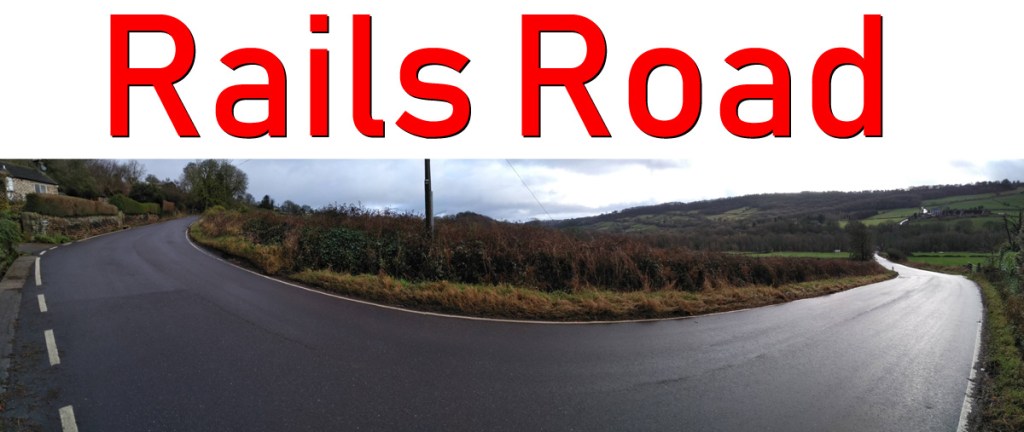
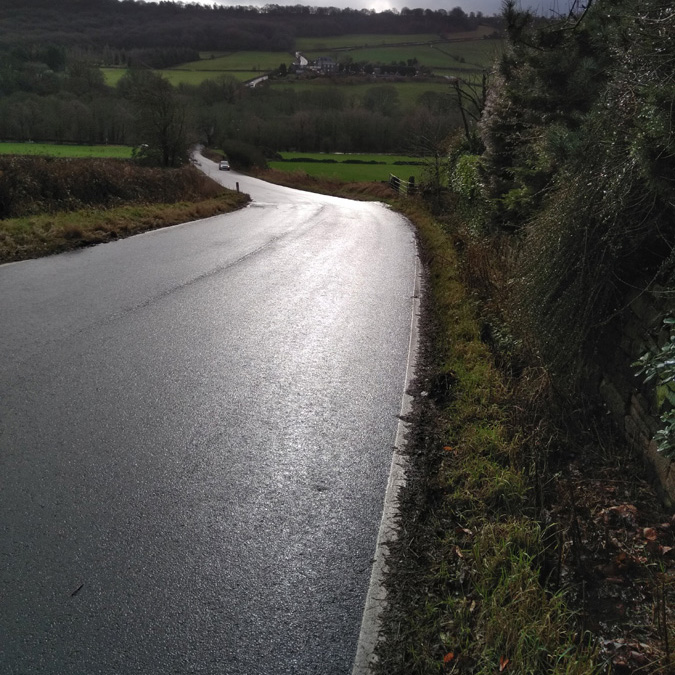
Sitting practically opposite Lodge Lane, Rails Road takes you up towards Stannington and to the cusp of some absolutely beautiful country cycling. You’re immediately on a gradient of 5-7% as you pull away from the nasty main road and in the distance you can see your main target: the sweeping right-hand bend.  There’s not many distinguishing features to pick out from the fields either side of you at this point but passing a large gate on your left is the signal for the road to ramp up into double figures.

The gradient continues to increase the closer you get to the bend, hitting a peak of 14.7% (although Strava claims 18.2%) just before you turn. You’re on the left, so it’s not quite as tricky as it could be but you’re still feeling the effort. Once you’re around the bend, you’ll run alongside a trickling culvert, which feels like it’s taunting you on a hot, sweaty day and shortly pass a footpath on your left which is where the Strava segment incorrectly shows a short, flat section. Let’s be clear: there is no short, flat section on his hill. It’s a GPS anomaly.

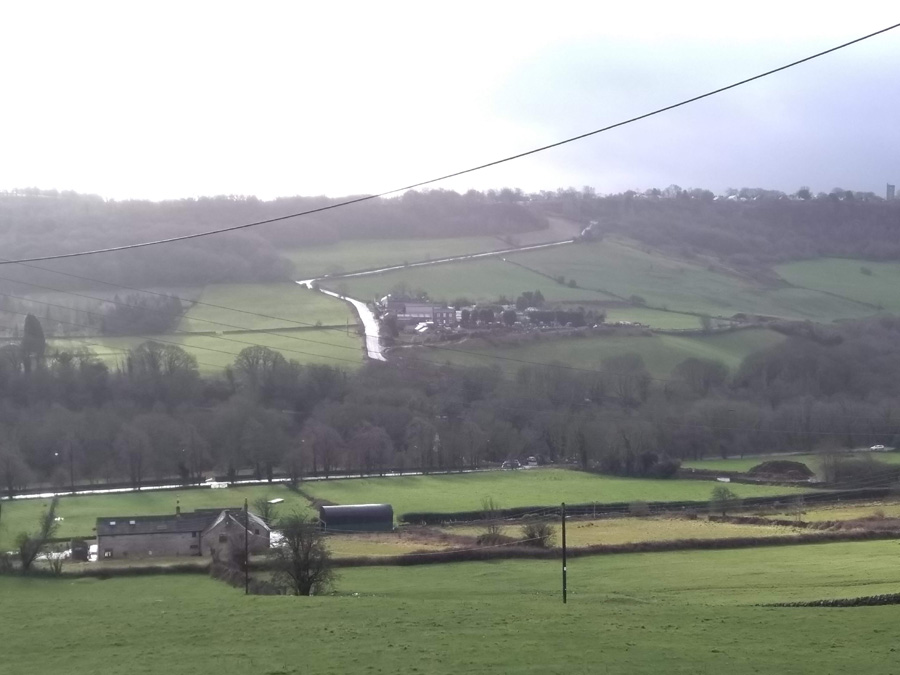
There is a slight relent in steepness as you reach Woodbank Road (and a great alternative route to the countryside) but carry straight on. The ride is getting easier with every pedal now and soon flattens out as you pass farmhouses on either side of the road and a gorgeous view across the Rivelin Valley.

Lodge Lane, seen from Rails Road

You can either continue on to Stannington (after another bonus bump) and head out into the Peaks towards Dungworth and Bradfield, or zoom back down the hill and tackle Rails Road’s evil twin: Lodge Lane.

Roper Hill

  • Roper Hill
  • Length: 0.23 miles 
  • Avg gradient: 10.4%   Peak gradient: 15.2%
  • Difficulty: 3/5
  • Likelihood of encountering unpleasant motor-vehicles: 1/5
  • Strava

I came across this climb when I was route planning and wanted the most direct way from Redmires Reservoir to Ringinglow Road. I didn’t realise until riding that near the beginning of that direct route lay Roper Hill.

It’s less than a quarter of a mile long but, for the unsuspecting rider, its a kick in the teeth. However, I’m sure it’s a joy for hill climbers and perfect for your hill reps. Indeed, last time I rode here there was a club doing reps, with one of their number playing Andy Williams’ It’s The Most Wonderful Time of the Year to motivate them uphill.

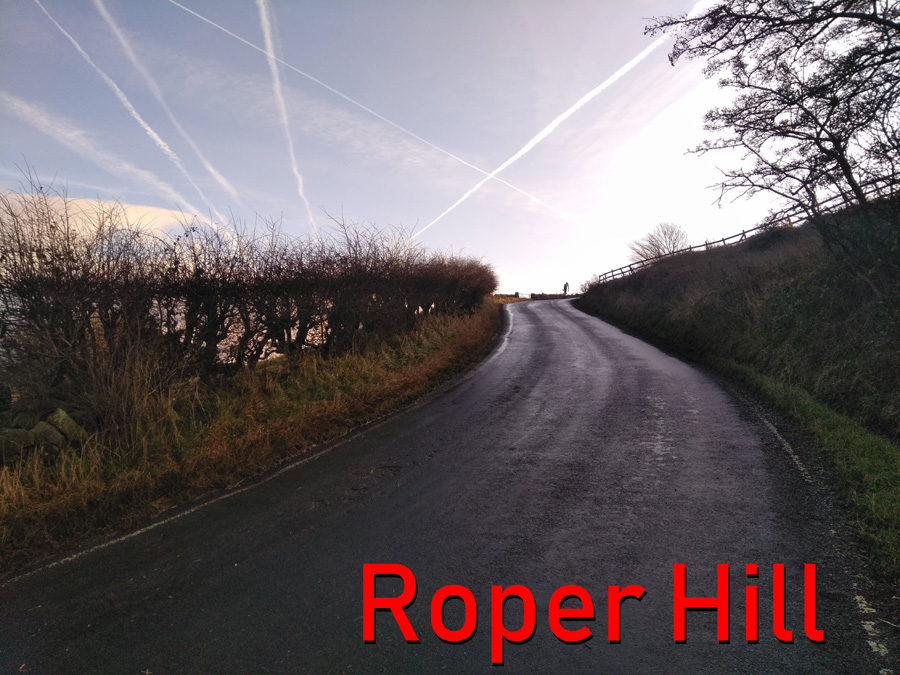
For the rest of us mortals though, prepare to dig in for a short, sharp blast. Roper Hill starts innocently enough as you turn in from Brown Hills Lane but very quickly ramps to about 8% up as you approach the first bend. The gradient only increases as you climb up the brief, straight section to the switchback. Luckily, you’re on the left, so the turn is not as punishing as it could be.

As you climb the next chunk, Roper Hill is holding a steady 11% but take a moment to glance to your right and appreciate the beautiful landscape beneath you. Let that, and the sight of the next bend at the hill’s apex (unfortunately also the steepest section at 15.2%), spur your legs on and you’ll soon be at the top.

From here, you’ve got a pleasant mile and a half ride, past the alpaca farm, to join Ringinglow Road and the options that presents.

Lodge Lane

  • Lodge Lane
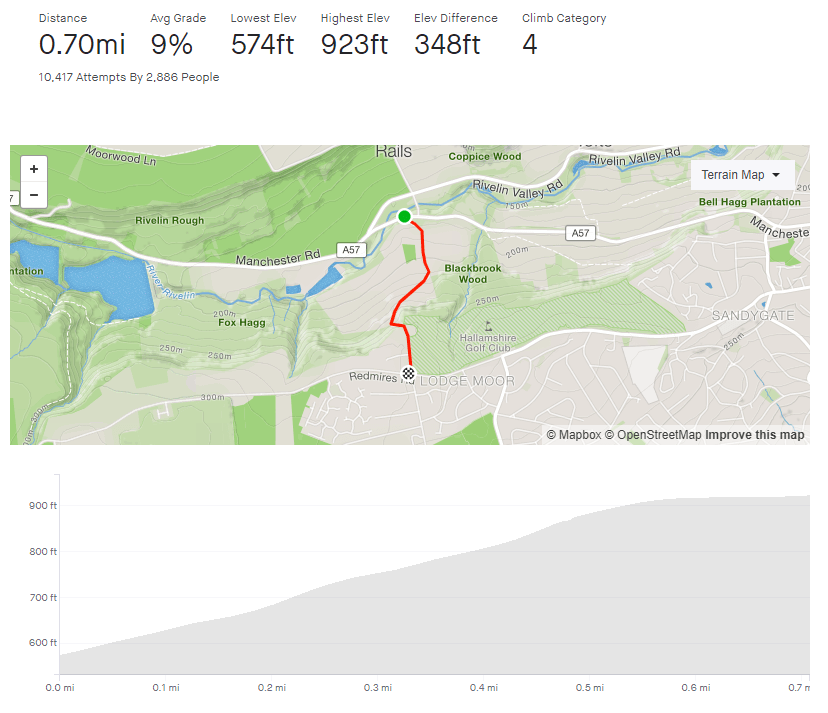
  • Length: 0.7 miles 
  • Avg gradient: 9.3%   Peak gradient: 15%
  • Difficulty: 4/5
  • Likelihood of encountering unpleasant motor-vehicles: 2/5
  • Strava

A few miles westward, out of the city, along the fairy nasty A57 Manchester Road you’ll find a couple of cheeky challenging climbs, escalating either side of the Rivelin Valley: Rails Road and Lodge Lane.  Rails Road will take you north up to Stannington, and Lodge Lane, south, to the green and pleasant lands of Lodge Moor.

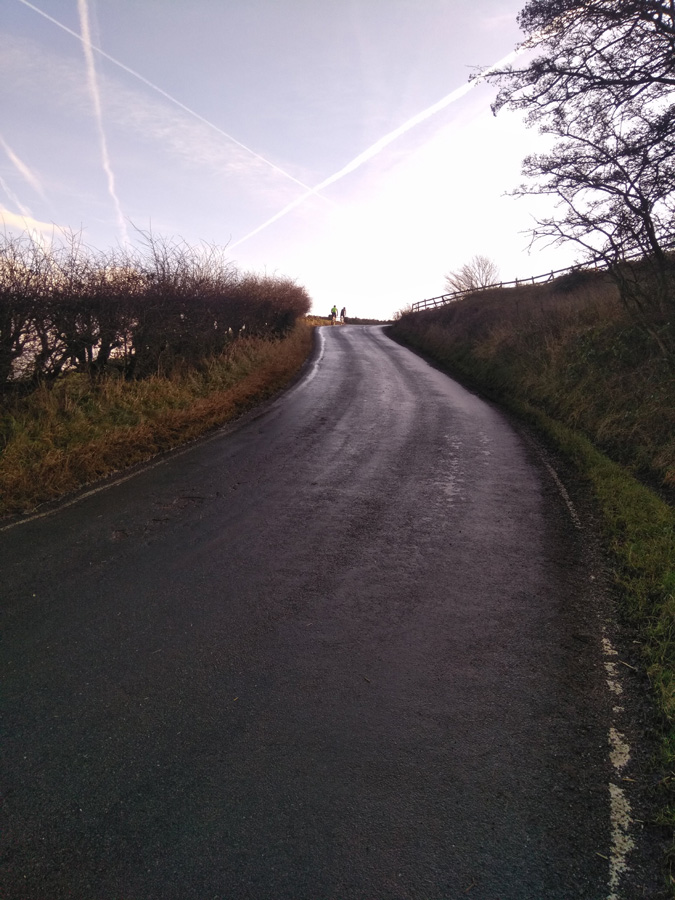
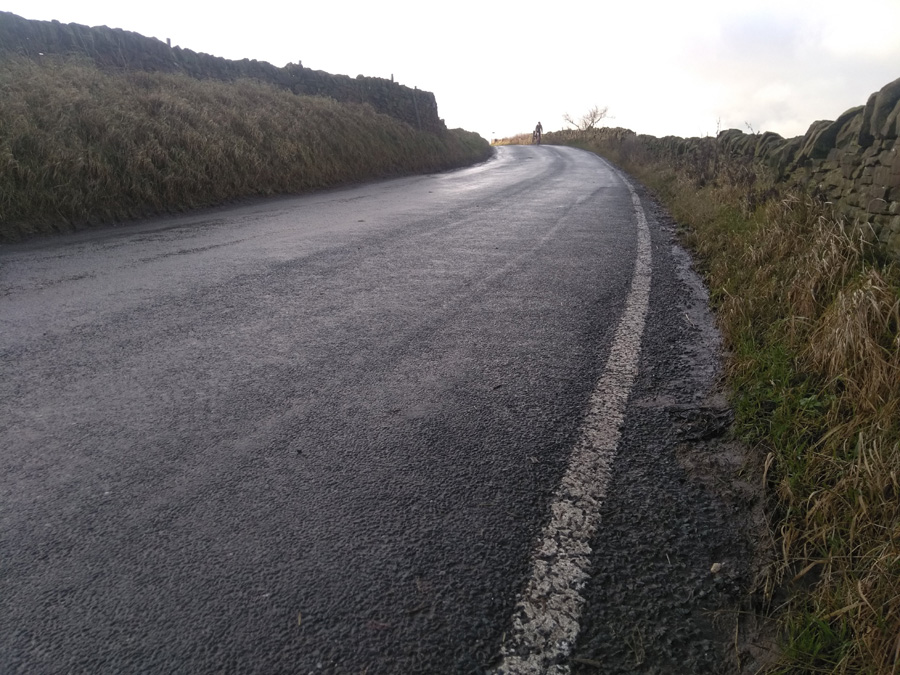
Like many of the roads that climb the Rivelin valley wall (see also: Hagg Hill), unless you’re lucky with oncoming traffic, you’re pretty much going to lose all of your momentum turning 90 degrees onto the hill.  Lodge Lane isn’t quite as a brutal start as Hagg Hill but you are straight into a 10% incline and a sharp left corner to begin.  The steepness gradually increases as you follow the road round a right-hand bend and are presented with a straight stretch open in front of you.

As you pass the campsite, the incline drops to around 7%, which feels comparatively flat, so use this section to ease off a bit before you prepare to dig in again. As the road heads to the next bend the gradient is back in double figures and although it’s only 0.1 mile I find this part tough because I know what’s around the next corner.  Since you’re now well above the valley with some lovely views towards the Peaks, it’s tempting to think you’re almost at the top.  You are not.

As the tree line returns and you round the next bend, I always expect to see the top of the hill, when all Lodge Lane offers you is more of the same.  In the distance, it’s not the end of the hill you can see but, at 15%, the hardest of the climb’s numerous bends. If you get round that, once you reach the roadside bollards you’ve made it and just need to pant on a few more feet to the end.

Now turn around, drop down at speed, and tackle Rails Road on the other side of the valley.

The Dale

  • The Dale
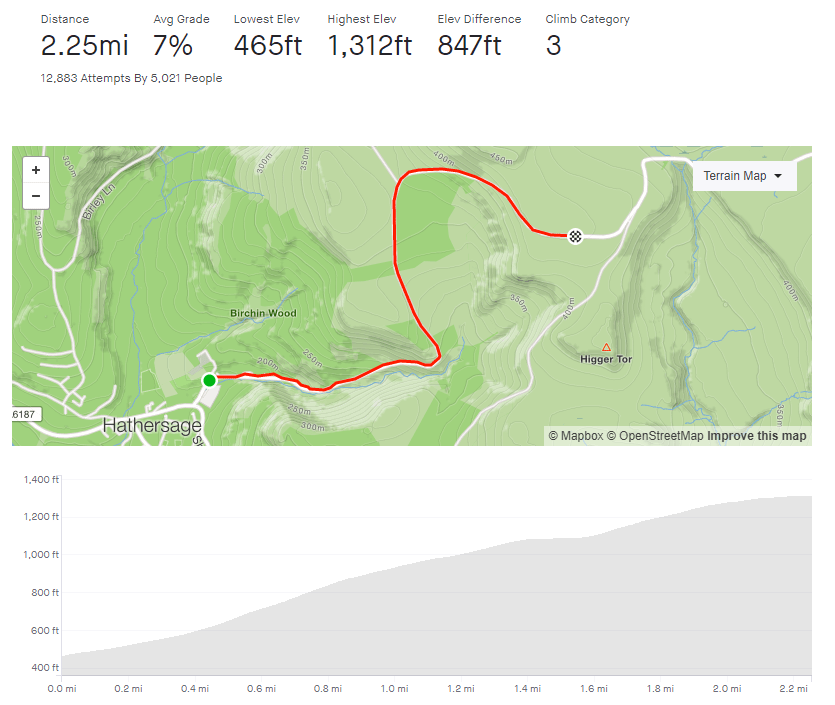
  • Length: 2.25 miles 
  • Avg gradient: 7%   Peak gradient: 12.9%
  • Difficulty: 4/5
  • Likelihood of encountering unpleasant motor-vehicles: 1/5
  • Strava

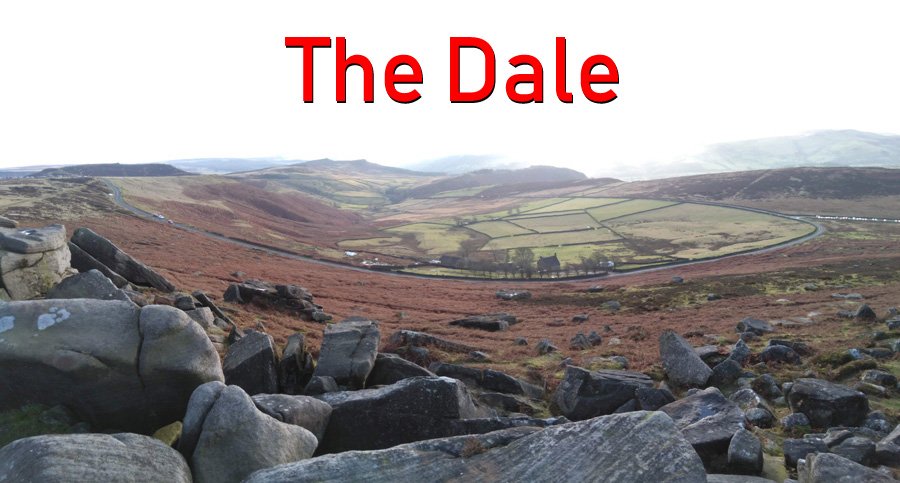
If you’re heading back to Sheffield from Hathersage there is the small matter of how you are going to get over the massive hill between the two places.  If you’re cycling on the road you’ve got three likely choices: The Dale, Fiddler’s Elbow and Surprise View.  All three are different in character and The Dale is definitely the steepest and most challenging.  The pay-off is that it’s also the quietest.

Having ridden down The Dale many times I was well aware of how steep it is and I was not surprised to discover how equally challenging it is to climb. The reward for your efforts, however, is some absolutely stunning scenery and an extraordinary sense of accomplishment.

As you leave Hathersage towards Sheffield, turn on to School Lane and follow the road past The Scotsmans Pack where the climb begins in earnest. For the first third of a mile, as you pass various quaint houses, the gradient fluctuates around the 5% mark.  Once you’re past those, and as the road bends round to the left, the gradient dramatically jumps into the teens.  The real fight starts here as you tackle The Dale’s steepest section but do hold something in reserve as you’ve still got a way to go.

As the tree cover gives way, revealing the valley that you’re carving up through, you just need to keep your head down and keep on pushing. You will eventually reach a sweeping left turn, where the gradient drops down to single figures (its still 8-9%, don’t go thinking it’s much of a relent) and your first sighting of the majestic Higger Tor.

You are now well past the hardest section of The Dale but you do still have over half the climb to do.  Luckily, the next section to Hook’s Carr car park (marked by a cattle grid) is far more manageable and, according to Strava, even drops to 0% at one point. Use that softening to recharge your legs in preparation for your attack on the last third of the hill.

Your final blast is where it all pays off.  The climb never goes above 11.4% for the last 0.8 miles yet you are gifted some absolutely stunning views as well as being able to look down into the Hope Valley and appreciate just how well you’ve done to get where you are.

A truly stunning Peak District cycling climb.

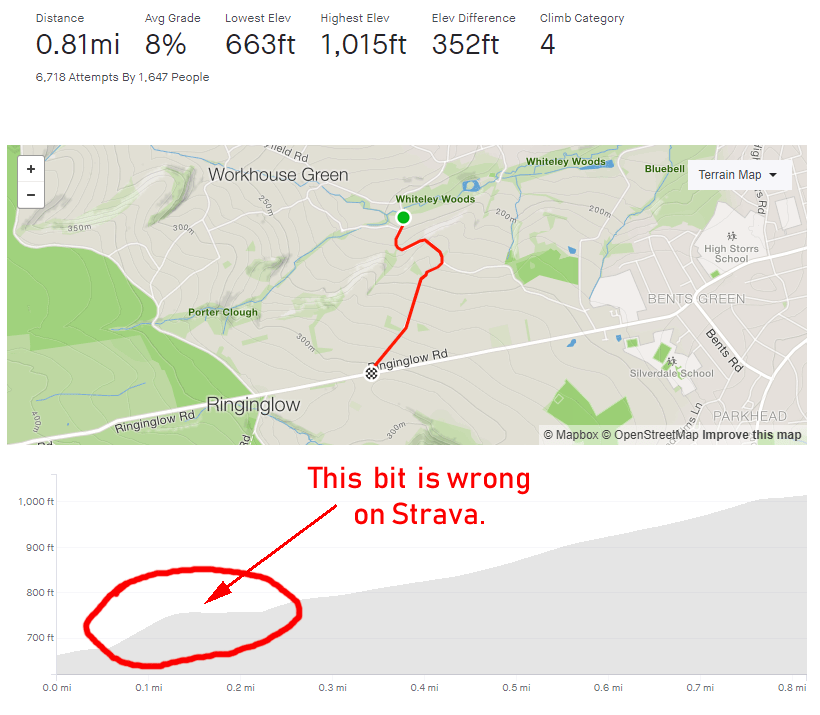
Woodcliffe & Hangram Lane

  • Woodcliffe & Hangram Lane
  • Length: 0.81 miles
  • Avg gradient: 8%   Peak gradient: 22.8%
  • Difficulty: 3/5 (steep but not too long)
  • Likelihood of encountering unpleasant motor-vehicles: 2/5
  • Strava  (Strava gets the hill’s topography incorrect. It appears as if there is a far longer flat stretch between the two climbs than there really is).

Woodcliffe and Hangram Lane is another route out of the suburbs to the edge of the Peak District but I was surprised to learn that it’s only 0.8 miles, as it feels much longer.  At its peak, you’ll join Ringinglow Road, about half-way up.  However, that hill will seem like a walk in the park once you’ve climbed this one.

The hill begins gently as the road crosses the Porter Brook but immediately picks up as it passes Clough Lane and curves around to the left. This is the hardest part of the climb and where the gradient quickly slips into double figures.  Do your best to dig in here, as this short straight section maintains its steepness until the next corner where the gradient touches the low 20s.

There is a brief blast of flat terrain before you turn right, onto Hangram Lane, where the road begins to climb once more.  You’ll pass a couple of houses before the the trees begin to drop away, revealing open farmland on either side.

Even though you’ve done the steepest bit and here the road is only averaging 7-9%, I always find this section more challenging as it feels more relentless.  Once you’re past the farm shop though, the end is in sight and you’ll shortly reach Ringinglow Road, where you can head downhill into Sheffield or upwards out into the Peak District.